

Ready-to-Bake, Pre-Proved or Fully Baked: Which Format Fits Your Kitchen?
October 13, 2026
Changing your bakery supplier is one of those decisions nobody notices when it goes well. When it goes badly, everyone notices: the breakfast buffet runs short, the croissants come out flat, an auditor asks for a certificate nobody can find.
The right supplier passes three tests. The product is the same every time, the supply arrives when promised, and the paperwork holds up when someone checks it. Below are the twelve questions we would ask if we were sitting on your side of the table, plus a ready-to-send version of the list at the end.
Key takeaways
- Test samples in your own ovens, with your own team, and hold them as long as your real service lasts.
- Compare the cost per piece you actually serve, not the price per carton.
- Get minimum orders, cut-off times and delivery temperatures in writing. In Dubai’s summer heat, the cold chain is not a detail.
- Check certificates yourself: the issuing body, what they cover and when they expire.
Start with the product, not the price list
Price matters, of course. But a cheaper croissant that needs a skilled baker to rescue it every morning is not cheaper. Begin with what lands on the plate.
1. Can we bake samples in our own kitchen, under real conditions?
A supplier’s showroom oven is always perfectly calibrated. Yours, at 6 a.m. on a Friday with a full brunch booking, probably is not.
Ask for samples and bake them exactly as you would on a normal day, with the staff who will actually do it. If you run more than one type of oven (a convection oven in the main kitchen, a small combi in the coffee shop), test in each.
Then hold them for as long as your service really lasts. A croissant that looks great for twenty minutes may be fine for a coffee shop counter. On a breakfast buffet that runs from 6:30 to 10:30 it has to look proud and crisp at the end too. A croissant that comes out flat at 7 a.m. cannot be rescued at 9.

2. How consistent is the product from box to box?
One great sample proves very little. What you are buying is the thousandth croissant, not the first.
When samples arrive, ask for them from different production batches. Take three pieces from different boxes and line them up. Compare the size, the weight, the colour after baking and, most of all, the cut surface. You want the same open, honeycomb crumb and the same even layers every time.
If a supplier is confident about consistency, they will be happy for you to do this in front of them.

3. Which formats do you supply, and which one suits our kitchen?
This is where a good supplier saves you money and a weak one sells you whatever is on their production plan this week. At Le’Craft we deliver fresh products ready to serve, and frozen products in four formats. Each option fits a different kind of kitchen:
| Format | What arrives | Work in your kitchen | Best for |
|---|---|---|---|
| Fresh | Baked and delivered, not frozen | Unpack and serve | Daily service without the time or equipment to bake |
| Ready-to-bake | Frozen, unproved dough | Thaw, prove, bake | Kitchens with a proving cabinet and a trained team |
| Pre-proved | Frozen, already proved | Straight from freezer to oven | Busy breakfasts, cafés without a baker |
| Fully baked | Baked and ready | Thaw or refresh briefly, then serve | Catering, inflight, events, remote sites |
| Ready-to-fill | Baked shells and bases | Fill and serve | Pastry sections, canapés, banqueting |

Many kitchens end up mixing formats: pre-proved croissants for the breakfast buffet, fully baked items for late-night room service, ready-to-fill shells for banqueting. Ask the supplier to recommend a mix for your outlets and explain why. If the answer is always “our most expensive line”, keep asking questions.
What matters most also depends on the kind of business you run:
| Your business | What to test hardest |
|---|---|
| Luxury hotel | Butter flavour, flake, appearance after two or three hours on the buffet |
| Business or airport hotel | Speed from freezer to oven, tolerance to mixed-skill staff, low waste |
| Resort | Steady volumes through the season, delivery reliability to your location |
| Café or coffee chain | Display life on the counter, range for the whole day, small order sizes |
| Caterer or airline | Fully baked options, portion consistency, documentation for audits |
If you would like to see how the formats compare across our range, you can request the Le’Craft catalogue.
For a detailed comparison of every format, read Ready-to-Bake, Pre-Proved or Fully Baked: Which Format Fits Your Kitchen?
Then check the supply side
Great pastry is useless if it is not in your freezer when you need it.
4. Where exactly is it made?
Some “local” suppliers are importers with a warehouse. That is not a problem in itself, but it means a longer chain, more time in transit and more hands touching the product.
Ask for the production address and, if it is nearby, ask to visit. Our own production is in Ras Al Khor, Dubai, and we are licensed by Dubai’s Department of Economy and Tourism. Whoever you choose, a supplier who makes the product locally can usually react faster when your plans change.
5. What are the minimum order, the lead time and the order cut-off?
Get all three in writing, per product. Then ask a few practical follow-ups:
- Can you mix products in one order to reach the minimum, or is every item sold in full cartons only?
- What is the daily cut-off for next-day delivery?
- What happens when you suddenly need twice your usual volume for a wedding, a conference or the first night of Ramadan?
You are looking for clear answers with real numbers, not “we’ll do our best”.
6. How does the product travel from your freezer to ours?
Frozen bakery products are normally stored at -18°C or colder. Every time they warm up and refreeze on the way, ice crystals grow inside the dough. You will not see it on delivery, but you will see it in the oven: less volume, a tighter crumb, a duller crust. In a city where summer afternoons pass 40°C, a few minutes on a loading bay matter.
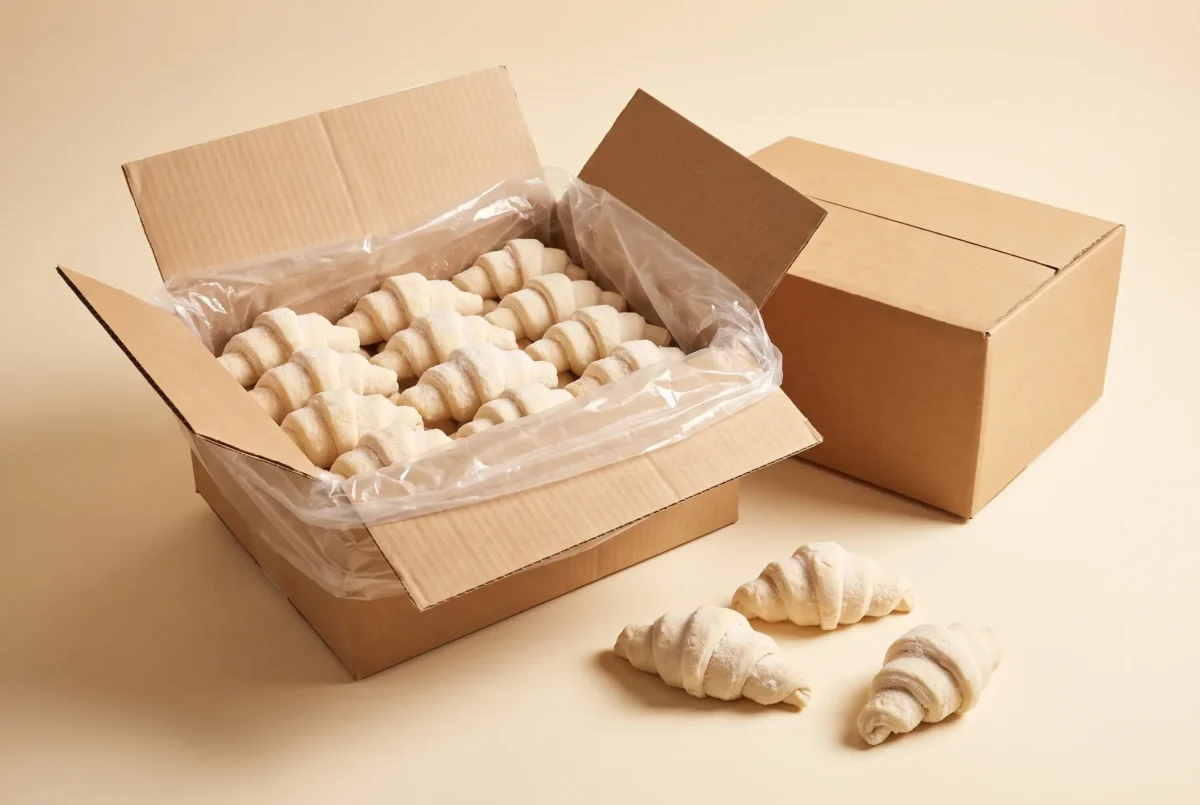
Ask how deliveries are made, how temperature is controlled on the way and whether they can share temperature records if there is ever a question. Then set up your own receiving routine:
- One named person receives bakery deliveries.
- Check one carton with a probe thermometer before signing.
- Look for warning signs: crushed cartons, torn liners, frost or ice inside the bag, pieces stuck together.
- Move everything into the freezer within 15 to 30 minutes.
- Rotate stock first in, first out.
7. What happens when an item is out of stock?
It will happen at some point. The question is whether you find out three days before or when the delivery arrives.
Ask how you will be told, how early, and what they will suggest instead. A good supplier proposes a close alternative before you have to ask.
Do the maths per piece, not per carton
Two croissants with the same carton price can cost very different amounts by the time they reach the guest. Before you compare quotes, work out the cost of each piece you actually serve.
| What to add up | Why it changes the real price |
|---|---|
| Price per piece | Cartons hold different counts, so compare per piece |
| Pieces lost | Broken in transit, misshapen, or failed in the oven |
| Unsold at the end of service | A product that holds well lets you bake in smaller waves |
| Labour | Proving and shaping time versus straight-to-oven formats |
| Delivery and minimums | Fees, and stock you were forced to buy to reach the minimum |
A slightly dearer croissant that holds for three hours and lets you bake in waves often ends up cheaper than a bargain one you throw away at 10 a.m.
Paperwork that will survive an audit
Hotels, airlines and retail chains audit their suppliers. Make sure yours can pass yours.

8. Which certificates can you show us?
Ask for copies, not just logos on a website. Typically you will want:
- A valid trade licence for food manufacturing.
- A halal certificate, with the name of the certifying body.
- Evidence of a food safety system, such as HACCP or ISO 22000 certification.
For each one, check who issued it, what it covers and when it expires. A certificate that covers a different site or has lapsed is worth nothing in an audit. And treat hesitation as information: a supplier who takes weeks to find a certificate usually takes weeks to answer other questions too.
9. Can you send specifications, allergen information and bake-off cards?
For every product you plan to buy, ask for a specification sheet. At minimum it should list ingredients, allergens, weight per piece, pieces per carton, storage temperature and shelf life.
Ask for a bake-off card as well: a one-page guide your team can pin up next to the oven, with thawing time, proving time if needed, oven temperature, baking time, pieces per tray and how long the product holds after baking. This single page does more for consistency than any training session.
If the sheets arrive quickly and are complete, the rest of the operation is usually organised too.
10. If there is ever a problem, how do you trace a batch and put it right?
Ask what is printed on each carton and how far back they can trace a batch, from finished product to ingredients. You hope you never need it. If you do, you will need it within hours, not days.
Ask too what happens when you report a quality issue. The best suppliers have a simple routine: you send the batch code, a few photos, the delivery date and how the product was stored and baked, and their quality team comes back with an answer and a fix.
The partnership questions people forget
Most buyers stop at price, quality and paperwork. The best relationships are built on the next two.
11. Can you develop something just for us?
A signature croissant, a pastry in your brand colours, a seasonal collection, a product sold under your own label: these are what make a menu or a retail shelf different from the place next door.
Ask whether the supplier offers private label and product development, how the process works and how long it takes. At Le’Craft we develop and produce private label and OEM products for partners, from recipe and testing through to regular supply.
12. Who do we call when something goes wrong, and how are problems settled?
Not a general inbox. A person with a name, a phone number and the authority to fix things.
Ask who your contact will be and how quickly they reply. Ask about payment terms, and what happens with damaged or rejected goods: are they replaced, credited, or argued over? We answer enquiries within one business day, and that is the minimum we would expect from any supplier we worked with ourselves.
A quick scorecard for your shortlist
Use this when you compare two or three suppliers side by side.
| Area | What good looks like | Red flag |
|---|---|---|
| Product | Same size, colour and crumb in every box | Great sample, uneven deliveries |
| Holding | Still crisp at the end of your real service | Only judged straight from the oven |
| Formats | A recommendation based on your kitchen | Pushes one format for everyone |
| Supply | MOQ, cut-off and lead times in writing | “We’ll do our best” |
| Cold chain | Clear answer on delivery temperatures | No answer, or a vague one |
| Paperwork | Certificates and bake-off cards within days | Logos only, no copies |
| Service | A named contact who replies within a day | A general inbox |
The 12 questions, ready to send
Copy this list into your next email to a potential supplier.
- Can we bake samples from different batches in our own ovens?
- How do you keep size, weight and lamination consistent from batch to batch?
- Which formats do you supply, and which would you recommend for our outlets?
- Where is the product made, and can we visit?
- What are the minimum order, lead time and daily cut-off? Can we mix products?
- How is temperature controlled from your freezer to ours?
- How and when will we hear about out-of-stock items?
- Can you send copies of your trade licence, halal certificate and food safety certification?
- Can you send specifications, allergen information and bake-off cards for each product?
- How do you trace a batch, and how do you handle a quality complaint?
- Do you offer private label or bespoke product development?
- Who will be our contact, what are your payment terms, and how are damaged goods handled?
Frequently asked questions
Two or three is usually enough. Fewer gives you nothing to compare; more turns into a tasting marathon and the details blur.
One main supplier for bakery keeps quality uniform and ordering simple. Some kitchens keep a second, smaller supplier as a backup for peak weeks. What rarely works is buying each item from whoever is cheapest that month.
Rarely. Many kitchens start with one category, often croissants and viennoiserie, run it for a month, and then move more of the range across.
Done well, yes, and more consistent. The lamination is done once, under controlled conditions, so your team only has to finish the product.
Your products of interest, the format you are considering, your oven types, how long your service lasts and the approximate weekly volume. It helps the supplier send the right samples the first time.
Ready to compare?

If you are reviewing your bakery supplier this season, we would be glad to be on your shortlist. Request our catalogue or talk to our team, and we will come back to you within one business day.