
How to Choose a Bakery Supplier in Dubai: 12 Questions to Ask
October 10, 2026
Hotel Breakfast Pastry Buffet: Quantities, Assortment and Less Waste
October 15, 2026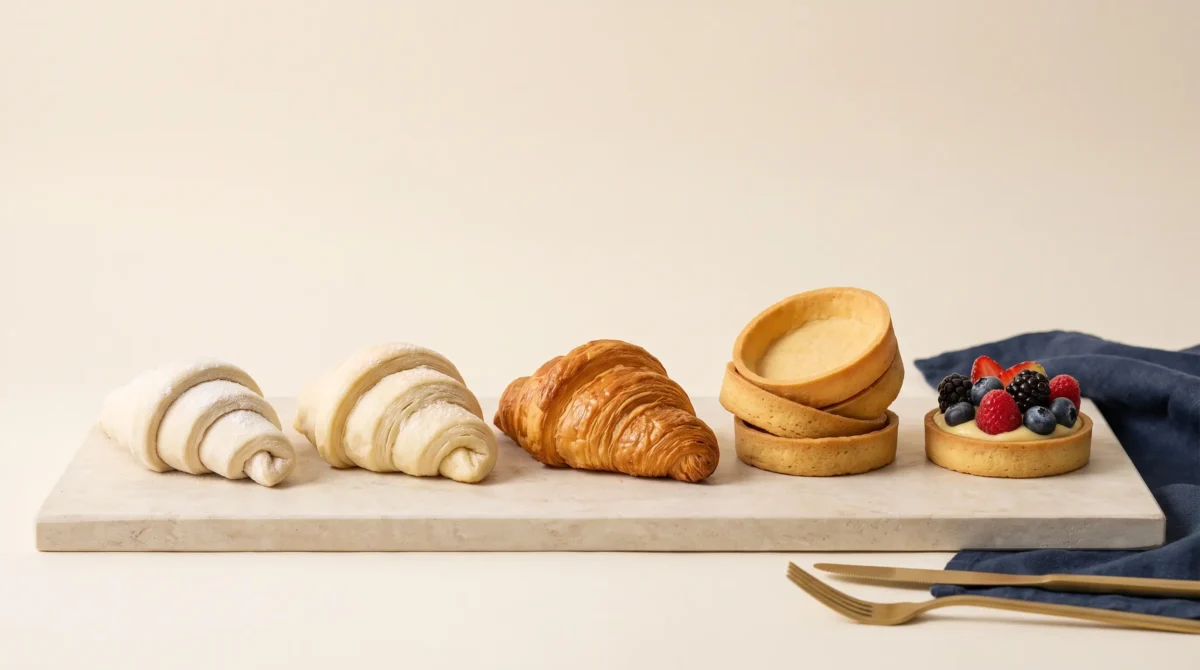
Most kitchens do not choose a pastry format once. They inherit one from the last supplier, or from a chef who left two years ago, and keep buying it long after the kitchen has changed around it.
The short answer to ready-to-bake vs pre-proved: ready-to-bake pastries suit kitchens with a proving cabinet and a trained early team who want the most control; pre-proved suits busy breakfasts and cafés without a baker, because it goes straight from freezer to oven. Fully baked suits caterers, airlines and anyone without an oven routine. Below we compare all of them, plus ready-to-fill shells and fresh delivery, so you can match the format to the kitchen you actually run.
Key takeaways
- Choose the format by your equipment and by who is on shift at 6 a.m., not by the price per carton.
- Ready-to-bake gives the most control and usually the lowest price per piece, but only with a proving cabinet and planning.
- Pre-proved goes straight from freezer to oven, which makes it the safest choice for mixed-skill teams.
- In the UAE, the cold chain matters more than anywhere: proved dough is the least forgiving of a warm loading bay.
In this guide
- Quick answer
- Five formats at a glance
- Same formats, different names
- Ready-to-bake
- Pre-proved
- Fully baked and par-baked
- Ready-to-fill
- Fresh delivery
- Why frozen dough is made differently
- What changes in the UAE
- Five questions that decide the format
- Which format fits which business
- Le’Craft products by format
- Cost per piece
- How to run a fair trial
- FAQ
Quick answer: which format should you choose?
| If your kitchen… | Start with |
|---|---|
| Has a proving cabinet and a trained pastry team on the early shift | Ready-to-bake |
| Bakes breakfast with a mixed or rotating team | Pre-proved |
| Has an oven but nobody who bakes | Pre-proved or fully baked |
| Has no oven to spare, or serves off-site | Fully baked |
| Makes its own creams and fillings for banqueting or afternoon tea | Ready-to-fill |
| Sells a small, steady daily volume and has little freezer space | Fresh delivery |
Five formats at a glance
Frozen bakery products are usually sold in three stages of readiness, and many suppliers add ready-to-fill bases and fresh delivery. At Le’Craft we make all five, so we can recommend a mix for your kitchen rather than push one format for everyone.
| Format | What arrives | Steps in your kitchen | Equipment you need | Best for |
|---|---|---|---|---|
| Ready-to-bake | Frozen, unproved dough | Thaw, prove, bake | Proving cabinet and oven | Hotels and bakeries with a trained team |
| Pre-proved | Frozen, already proved | Bake from frozen | Oven only | Busy breakfasts, cafés without a baker |
| Fully baked | Baked, then frozen | Thaw or refresh briefly | Oven or none | Catering, inflight, events, remote sites |
| Ready-to-fill | Baked shells and bases | Fill and serve | Chiller for fillings | Pastry sections, canapés, banqueting |
| Fresh | Baked and delivered, not frozen | Unpack and serve | None | Daily service without baking at all |
Same formats, different names
Suppliers, distributors and recipe books use different words for the same thing, which makes quotes hard to compare. This is how the most common terms line up.
| What we call it | Also known as |
|---|---|
| Ready-to-bake | Unproved, raw frozen dough, freezer-to-proofer, proof and bake, thaw-proof-bake |
| Pre-proved | Pre-proofed, pre-fermented, freezer-to-oven, bake from frozen |
| Par-baked | Part-baked, half-baked, bake-off bread |
| Fully baked | Thaw and serve, freezer-to-table, baked and frozen |
| Ready-to-fill | Tart shells, cases, canapé bases, pastry cups |
When two quotes use different words, ask the supplier one simple question: what exactly does my team have to do between the freezer and the plate?
Ready-to-bake: the most control, the most work
Ready-to-bake dough arrives frozen and unproved, shaped but not yet risen. Your team takes it out of the freezer, lets it thaw, proves it until it has roughly doubled, then bakes it. Done well, this is as close as you get to a croissant made on site: full volume, deep colour, a crisp shell and an open, buttery crumb.
The catch is time and judgement. Proving usually takes one to three hours, depending on the product and on how warm and humid your cabinet runs. Prove too little and the croissant bakes tight and bready. Prove too much and the layers collapse and leak butter in the oven. Someone has to make that call every morning, often before the head pastry chef arrives.
- Choose it if you have a proving cabinet, a pastry or bakery team on the early shift, and freezer space for larger orders.
- Think twice if your breakfast is baked by a night cook or a rotating team, or if you cannot plan your volumes a few hours ahead.
- Hidden benefit: unproved dough is compact and robust, so it usually travels and stores better than proved pieces, and the price per piece is often the lowest of the three frozen stages.
Pre-proved: from freezer to oven
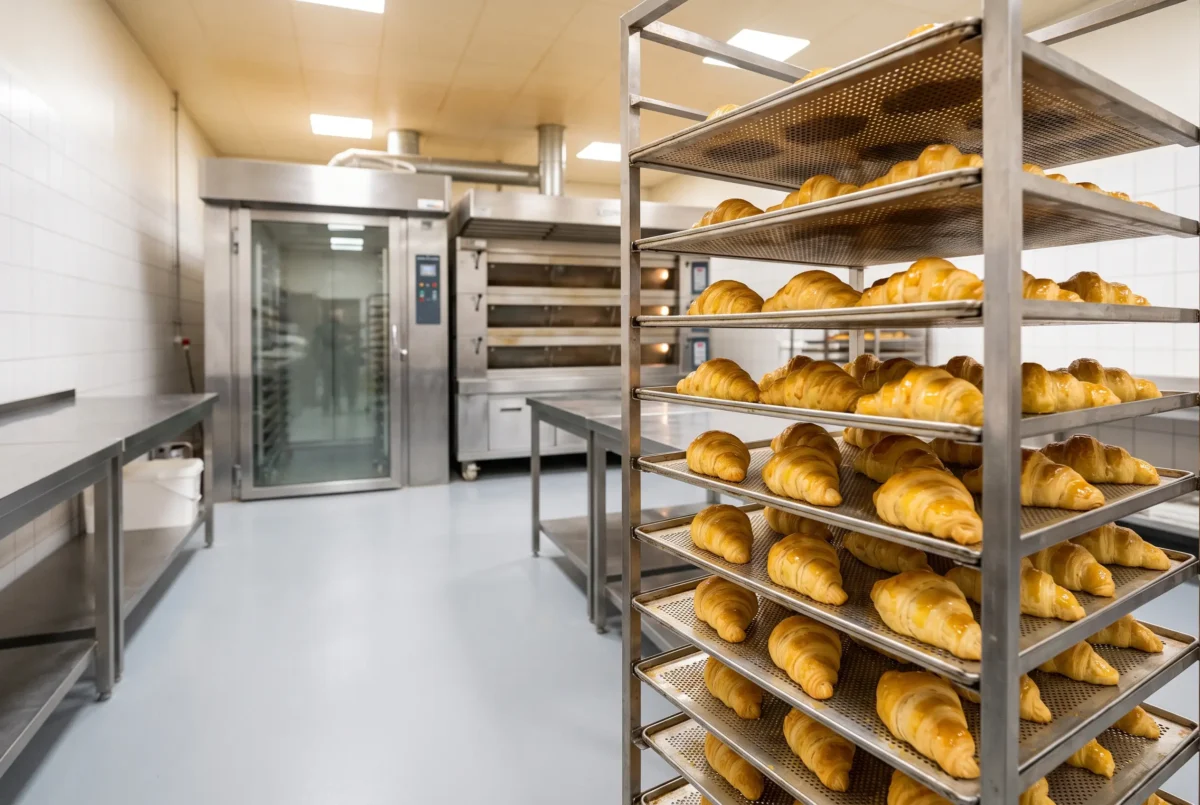
Pre-proved pastry has already been proved at the factory, under controlled conditions, then frozen. Your team puts it straight from the freezer into a preheated oven. There is no proving cabinet, no waiting and no judgement call about when the dough is ready.
That is why pre-proved has become the default for hotel breakfasts and coffee chains. You can bake a tray of twelve at 6:15, another at 7:30 and another at 9:00, so the buffet always looks freshly stocked and you throw away far less at the end of service. We show how to plan those waves in our hotel breakfast pastry buffet guide.
The trade-offs are small but real. Proved dough is airy and more fragile, so cartons need careful handling and the cold chain must not break: if pre-proved pieces warm up and refreeze, they lose volume that no oven can give back. The price per piece is usually a little higher than ready-to-bake, which is often repaid by the labour and the waste you save.
- Choose it if you need fresh pastry at several moments of the day, your team has mixed skills, or you have no proving cabinet.
- Think twice if your freezers are crowded or your deliveries sit on a loading bay before anyone signs for them.
Fully baked and par-baked: pastry without a baking routine
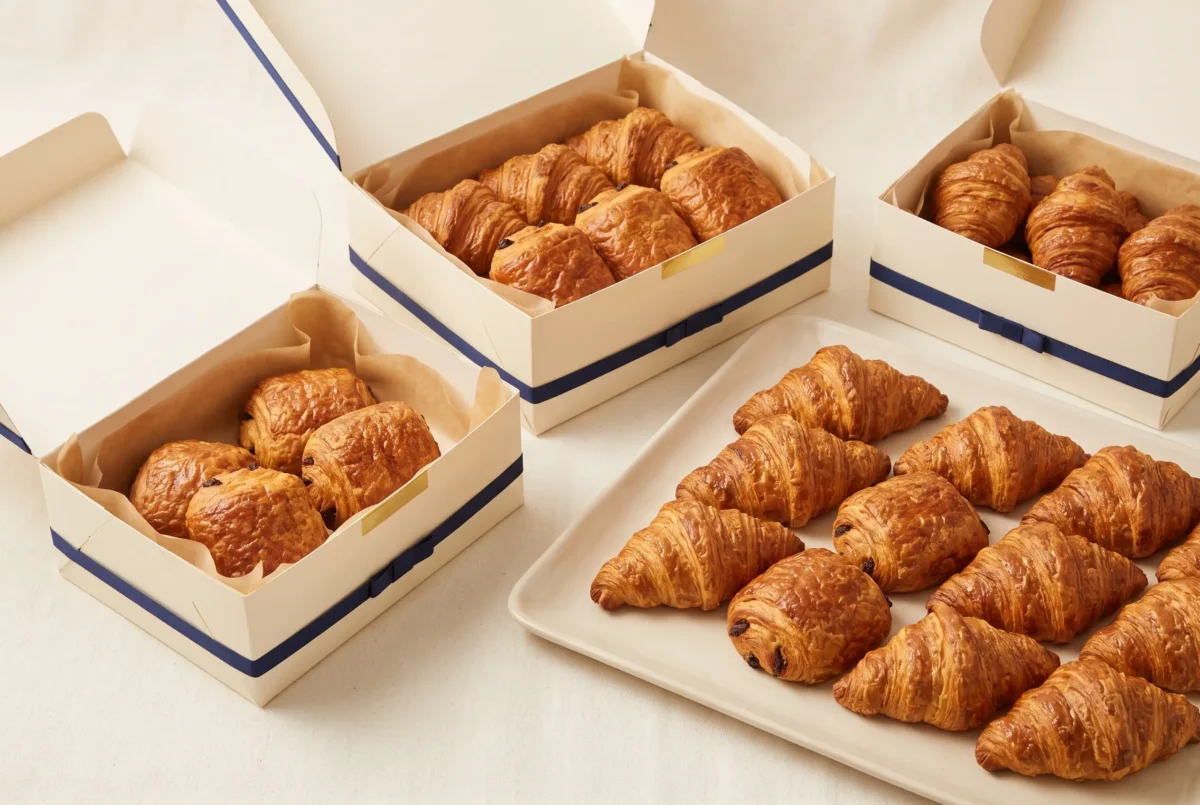
Fully baked products leave the factory finished and are then frozen. In your kitchen they only need to thaw, or to go into a hot oven for a few minutes to bring back the crisp crust. Nobody needs to know how to bake, and the result looks the same whoever is on shift.
This is the natural format for outside catering, airlines, events, staff canteens and remote sites, where there is no time, no oven to spare or no one to bake. It also works as a safety net in hotels: a few cartons of fully baked croissants in the freezer will rescue a late room-service order or an unexpected group.
Fully baked pastry gives you the least control over the final bake, so judge it the way your guest will eat it: refreshed, on the plate, after the time it really waits. A good fully baked croissant should still flake and taste of butter, not of the freezer.
Par-baked sits between pre-proved and fully baked, and is most common for bread. The loaf is baked until its structure is set but before the crust browns, then frozen. A short bake in your oven finishes the colour and the crust, which gives you the smell and crackle of fresh bread with very little skill.
Ready-to-fill: shells and bases for your own fillings
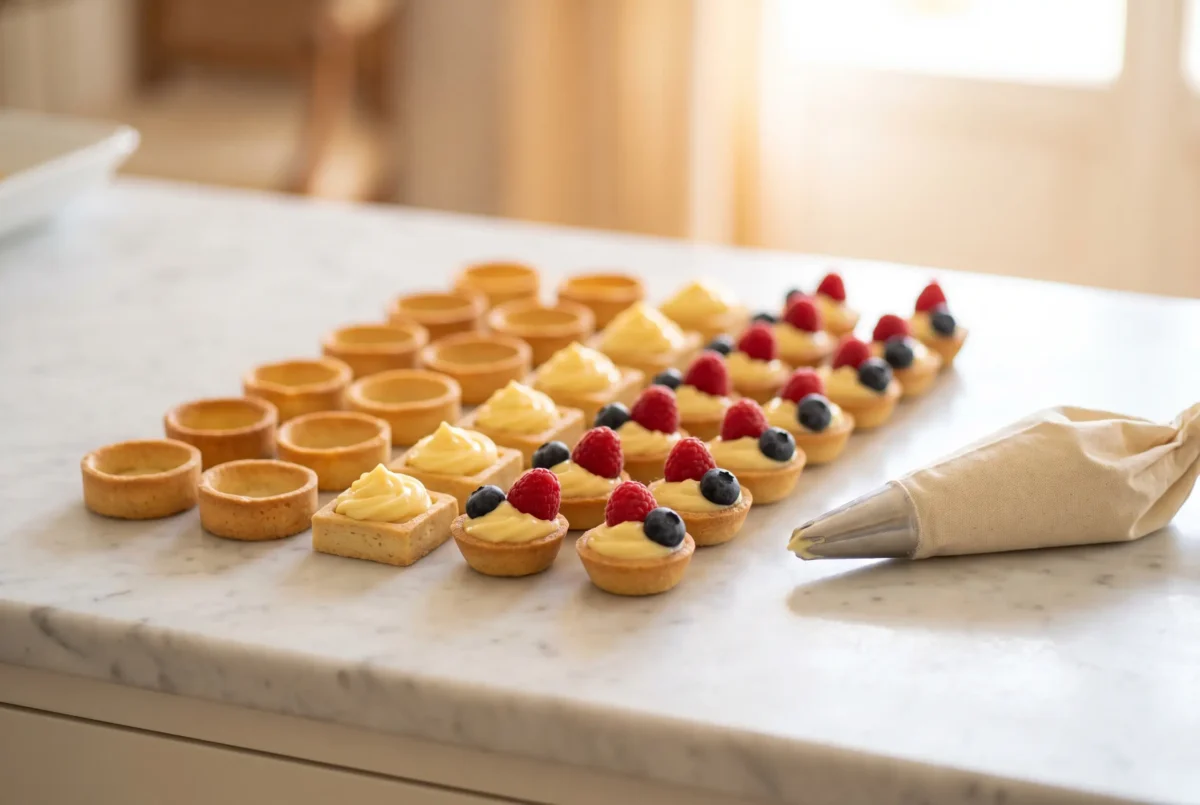
Ready-to-fill products are baked tart shells, choux, canapé bases and similar pieces that your team fills with its own creams, fruit, mousses or savoury mixtures. You keep the creative part, the filling, and skip the part that takes skill and time: rolling, lining and blind-baking hundreds of identical shells.
They are a favourite of banqueting and pastry sections, where a single wedding can need a thousand mini tartlets that all look exactly the same. Store them dry and well sealed, and fill as close to service as you can so the base stays crisp.
Fresh delivery: when you don’t want to bake at all
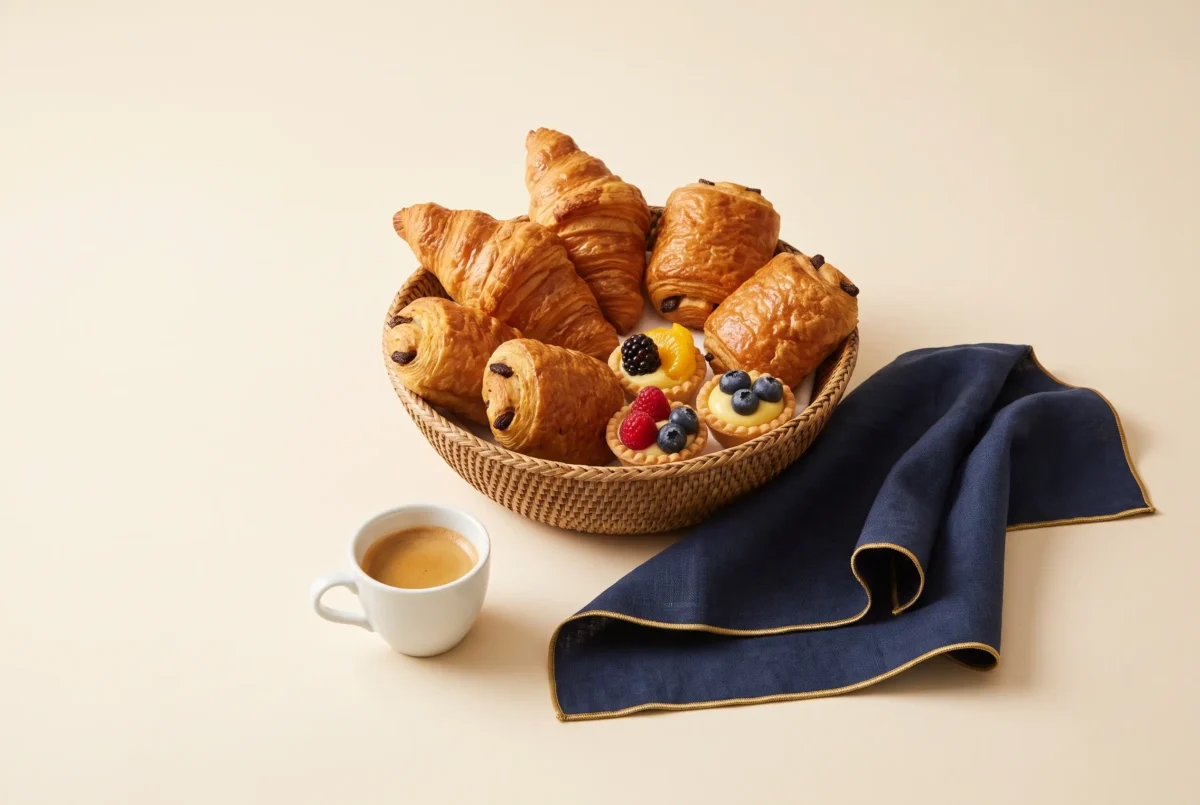
Not every kitchen should bake. If you have no oven to spare, very little freezer space or simply a small, steady daily volume, fresh pastry delivered ready to serve can be the simplest answer. At Le’Craft we supply fresh products alongside our frozen range, so a café can, for example, take fresh cakes and desserts every day and bake only its croissants from frozen.
Fresh products have a short life, so they suit businesses that can predict their daily volume and receive regular deliveries. You can see how fresh and frozen supply compare on our products page.
Why frozen dough is made differently
A good frozen croissant is not simply a fresh croissant put in a freezer. Freezing is hard on dough: water turns into ice crystals that can tear the gluten network, and yeast loses some of its strength in the cold. Producers design for this from the start.
- Recipe. Frozen doughs typically use stronger flour and more yeast than a bake-today dough, so they still rise fully after weeks in the freezer.
- Fast freezing. Pieces are blast frozen quickly after shaping. The faster the freeze, the smaller the ice crystals and the less damage to the layers.
- Steady cold. Once frozen, the product should stay at -18°C or colder all the way to your oven. Every warm-up and refreeze grows the ice crystals again, which is why a carton that sat on a dock bakes flatter.
- Butter and lamination. In laminated pastry, cold, plastic butter keeps the layers separate. If it softens and refreezes, layers merge and the crumb closes up.
This is also why the format matters for quality, not just for labour. Unproved dough is dense and holds up well to small temperature swings. Proved dough is full of delicate gas bubbles and is the least forgiving.
What changes in the UAE
The formats are the same everywhere, but kitchens in Dubai and across the Gulf face a few conditions that shift the choice.
- Heat and the last mile. With summer temperatures above 40°C, a few minutes between the truck and the freezer matter. If your receiving is not tightly controlled, robust formats such as ready-to-bake or fully baked forgive more than pre-proved.
- Ramadan and Eid peaks. Iftar buffets, suhoor menus and Eid gifting can multiply pastry volumes for a few weeks. Pre-proved and fully baked formats let you scale up without adding bakers for the season.
- Seasonal occupancy. Hotel volumes swing between the cooler high season and the summer. Frozen formats let you hold stock through peaks without over-ordering fresh product.
- Multi-outlet properties. Large resorts often run several kitchens, lounges and cafés with very different equipment. A format per outlet usually works better than one format for the whole property.
The best format is the one the least experienced person on your earliest shift can bake perfectly on a busy morning. Start from that person, then choose the product.
Le’Craft Pastry Team
Five questions that decide the format
Before you compare samples or prices, answer these five questions honestly. They narrow the choice faster than any tasting.
- What equipment do you have, and where? A proving cabinet in the main kitchen does not help the lobby café on the other side of the building.
- Who bakes at the moment it matters? Plan for the least experienced person on the earliest shift, not for your best pastry chef.
- How does your service run? One big peak, like a breakfast buffet, or steady sales from morning to evening, like a coffee shop counter?
- How much freezer space do you have? Pre-proved and fully baked pieces take more room per piece than unproved dough.
- How reliable is your receiving? If deliveries can wait on a dock, choose formats that are more forgiving, or fix the receiving routine first.
Which format fits which business?
These combinations work well for most kitchens. Treat them as a starting point, not a rule.
| Business | Usual main format | Often added |
|---|---|---|
| Luxury hotel breakfast | Ready-to-bake or pre-proved | Ready-to-fill for the pastry section |
| Business or airport hotel | Pre-proved | Fully baked for room service and late arrivals |
| Café or coffee chain | Pre-proved | Fresh cakes and desserts |
| Restaurant | Pre-proved or fully baked | Fresh bread and desserts |
| Airline or outside caterer | Fully baked | Ready-to-fill for canapés |
| Supermarket in-store bakery | Ready-to-bake or pre-proved | Fully baked for packed shelves |
| Banqueting and events | Ready-to-fill | Fully baked viennoiserie |
Le’Craft products by format
| Product family | Formats available | Typical use |
|---|---|---|
| Viennoiserie & laminated dough | Ready-to-bake · Pre-proved · Fully baked | Breakfast buffets, cafés, room service |
| Puff pastry | Ready-to-bake · Fully baked | Palmiers, turnovers, savoury bites |
| Artisan breads & baked goods | Fully baked | Bread baskets, sandwiches, buffets |
| Tart shells & canapé bases | Ready-to-fill | Banqueting, afternoon tea, canapés |
| Premium desserts, macarons & choux | Frozen, ready to serve | Dessert counters, events, room service |
Fresh products are available alongside the frozen range for kitchens that would rather not bake at all. You can browse the full range on our products page or request the Le’Craft catalogue, and our team will reply within one business day.
Mixing formats is normal
Very few kitchens run on a single format. A typical five-star hotel might bake pre-proved croissants and pain au chocolat in waves for the breakfast buffet, keep fully baked pieces for room service and the executive lounge, and use ready-to-fill shells for afternoon tea and banqueting.
Mixing formats is not a compromise. It means each outlet gets the format that suits its equipment and its people. The only rule is to keep the range consistent, ideally from one supplier, so the croissant in the lounge looks and tastes like the one on the buffet.
Compare the cost per piece you serve
Price lists compare cartons. Your P&L compares pieces that reach a guest. Ready-to-bake usually has the lowest price per piece, but add the proving time, the staff who manage it and the trays that fail on a bad morning. Pre-proved and fully baked cost more per carton, but often less per piece served once labour and waste are counted.
We go through this calculation step by step in How to Choose a Bakery Supplier in Dubai: 12 Questions to Ask.
How to run a fair format trial
If you are torn between two formats, test them side by side for a week, not a morning.
- Ask for samples of the same product in both formats, for example a butter croissant ready-to-bake and pre-proved.
- Bake them in your own ovens, with the team that will really do it, following each product’s bake-off card.
- Bake at your normal times and hold the pieces as long as your real service lasts.
- Write down the labour minutes, the pieces lost and the pieces left at the end of service.
- Ask a few colleagues and regular guests to compare them blind, then decide on the numbers and the plate together.
Frequently asked questions
Ready-to-bake dough is frozen before proving, so your team thaws and proves it before baking. Pre-proved dough is proved at the factory before freezing, so it goes straight from the freezer into the oven.
Yes, if they are pre-proved or fully baked. Ready-to-bake croissants need to thaw and prove first, otherwise they bake small and dense.
Not necessarily. Pre-proved dough is proved under factory conditions that are often more stable than a busy hotel kitchen. Ready-to-bake gives you more control, which helps if you have the skills and equipment to use it.
Proof-and-bake means unproved dough that your team proves and bakes. Thaw-and-serve means fully baked products that only need to thaw or be briefly refreshed.
Ready-to-bake needs a proving cabinet and an oven. Pre-proved and par-baked need only an oven. Fully baked, ready-to-fill and fresh products can be served with no baking equipment at all.
At -18°C or colder, in its sealed liner, and used first in, first out. Avoid opening and resealing cartons repeatedly, and never refreeze pieces that have thawed.
Yes. Many kitchens start with pre-proved for simplicity and move some products to ready-to-bake once their team and equipment are in place, or the other way round when staff change.
No. It depends on the product: a croissant can be supplied in several frozen stages, while tart shells are naturally ready-to-fill. Ask your supplier for the formats available for each item on your list.
Our minimum order is 150 units of product per order, and standard catalogue products are dispatched within 24 hours of order confirmation.
Not sure which format fits your kitchen?
Tell us about your outlets, your ovens and your busiest service, and we will suggest a format mix that fits. Request our catalogue or talk to our team, and we will come back to you within one business day.