

Ready-to-Bake, Pre-Proved or Fully Baked: Which Format Fits Your Kitchen?
October 13, 2026
Every hotel breakfast has the same two failures. At 10:15 the croissant basket is empty and a guest who paid for breakfast gets a sad brioche. At 10:45 the kitchen throws away three trays of pastries nobody touched. Most buffets manage to do both in the same week.
The short answer: plan hotel breakfast buffet pastries from your forecast covers, not from the number of rooms; measure how many pieces your guests really take; bake in two or three waves instead of one big bake at 6 a.m.; and keep a small core assortment that rotates around it. The rest of this guide shows how to do each step, with a simple calculation you can run tomorrow morning.
Key takeaways
- Bread and pastry are among the most wasted items on hotel breakfast buffets, so they are also where the biggest savings are.
- Forecast covers from occupancy and breakfast take-up, then use your own take-rate per guest, not a generic rule.
- Bake in waves from frozen: a smaller first bake, then top-ups driven by what the buffet is actually using.
- Keep a stable core of five or six items, rotate one or two, and make the last hour of service deliberately smaller.
In this guide
- Why pastry leads buffet food waste
- It pays for itself
- Start from covers, not rooms
- How many pastries per guest?
- Bake in waves, not in one go
- Build the assortment
- Pastry display: full, not overloaded
- What to do with what is left
- Involve the team
- Measure for two weeks
- Plan for peaks
- FAQ
Why pastry leads hotel breakfast buffet food waste
Pastry is cheap per piece, easy to over-produce and loses its appeal within hours, which is exactly the recipe for waste. Kitchens bake generously at the start so the buffet looks abundant, and whatever is left at the end cannot go back on tomorrow’s display.
The data backs this up. In a four-month pilot across 13 hotels in the UAE, Hilton, Winnow and the national food-waste initiative ne’ma cut breakfast food waste by 62%, and bread and pastry were named among the most wasted items (Hospitality Net, 2023). At Novotel Brisbane, daily waste tracking showed that breakfast pastries were the single biggest loss. The team stopped baking slow sellers in bulk and split the croissant bake into a second, demand-led batch (Leanpath case study).
The lesson is the same in both cases: the savings did not come from offering less, but from producing closer to real demand.
It pays for itself
Cutting waste is not only good for the planet; it is one of the fastest returns a kitchen can get. Research by Champions 12.3 across 42 hotels in 15 countries found that the average hotel invested less than 1% of its food sales in reducing waste and got about seven times that back, and 95% of hotels recovered the investment within two years (World Resources Institute).
The same work found that over 70% of food waste in hospitality happens before the food reaches a plate: in production and on the buffet. That is exactly where pastry planning sits, and where the steps below make the difference.
Start from covers, not rooms
A 300-room hotel at 90% occupancy does not serve 300 breakfasts. Start every plan with a forecast of covers, the number of people who will actually eat breakfast tomorrow.
- Occupied rooms from tonight’s in-house list.
- Guests per room. Business hotels often sit close to one; resorts and family hotels are higher.
- Breakfast take-up. Bed-and-breakfast packages, room-only rates and early checkouts all change who comes down.
- Adjustments. Groups, early flights, conferences, weekend brunch and local guests who come in for breakfast.
Your front office and revenue team already have most of these numbers. A five-minute call at 4 p.m. turns them into tomorrow’s production plan.
How many pastries per guest?
There is no universal number, and anyone who gives you one is guessing. A business hotel full of guests who grab a coffee and a croissant behaves very differently from a resort where families linger for two hours. What you need is your own take-rate, and it takes about two weeks to measure.
Count, for each day, how many pastries went out and how many came back, then divide by covers. Once you know your numbers, the plan is one line:
Pieces to plan = forecast covers × share of guests who take pastry × average pieces per pastry eater
Here is how it works with example numbers. Replace them with your own as soon as you have them.
| Step | Example | Result |
|---|---|---|
| Forecast covers | 280 guests tomorrow | 280 |
| Share who take pastry | 6 in 10 guests (your measured rate) | 168 pastry eaters |
| Pieces per pastry eater | 1.5 on average (your measured rate) | about 250 pieces |
| Split across the assortment | Croissant 35%, pain au chocolat 25%, Danish 20%, mini muffins and tarts 20% | 88 / 63 / 50 / 50 |
Plan the total, but do not bake the total at 6 a.m. That is the next step.
Bake in waves, not in one go
The single most effective change most buffets can make is to stop baking everything before service. With pre-proved pastry that goes straight from freezer to oven, a small first bake and regular top-ups are easy, and every tray reaches the buffet warm.
| Wave | When | Share of the plan | Based on |
|---|---|---|---|
| First bake | Before doors open | About 40% | The forecast |
| Second bake | First peak | About 30% | What has gone in the first hour |
| Third bake | Mid-service | About 20% | What is moving, item by item |
| Top-up | Last hour | Only what is needed | Keep the display smaller on purpose |
Treat these shares as a starting point and adjust them to your own peak times. If your format needs proving first, plan the proving cabinet so that each wave is ready on time. We compare the formats in detail in Ready-to-Bake, Pre-Proved or Fully Baked: Which Format Fits Your Kitchen?
Build the assortment: a stable core and a small rotation
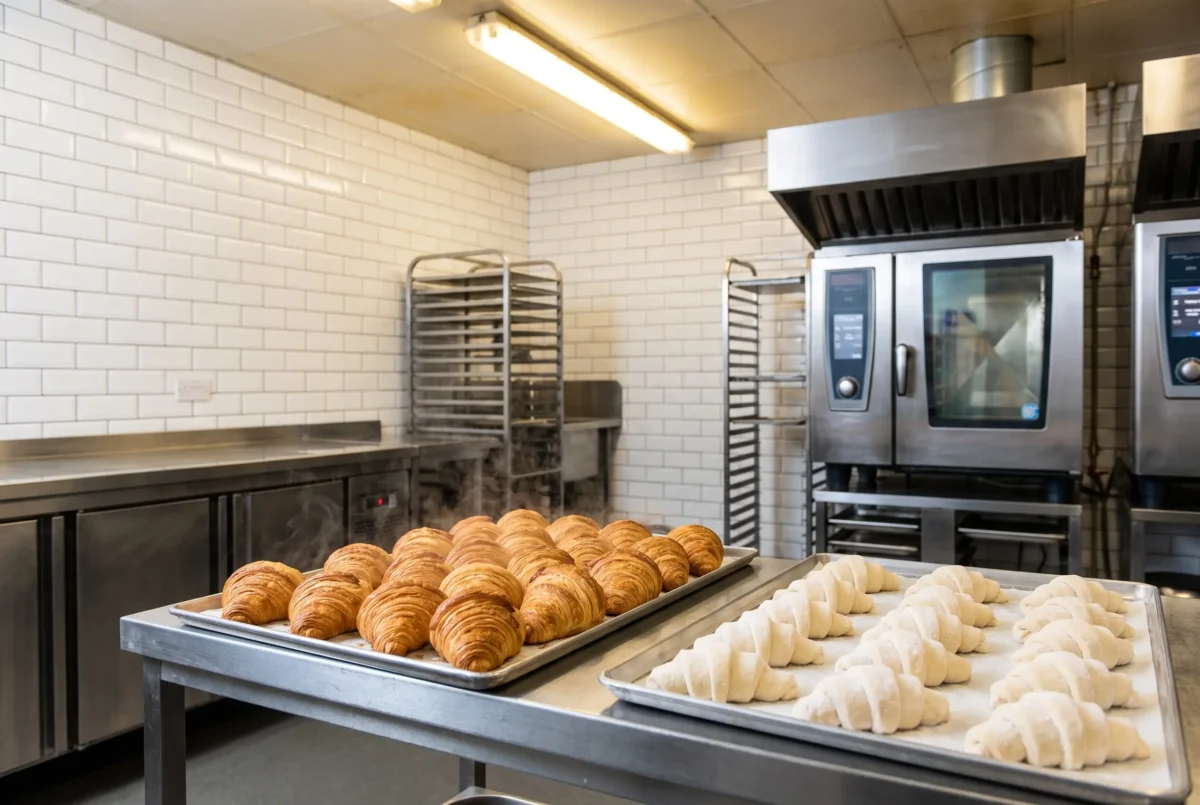
Guests want their favourites every day and something new on the third morning of their stay. A stable core with a small rotation gives them both, and keeps your forecast accurate.
| Role | Typical items | Why |
|---|---|---|
| Core every day | Butter croissant, pain au chocolat | The two items almost every guest looks for |
| Core every day | One fruit Danish or swirl | Colour on the display, a sweeter option |
| Core every day | Bread rolls or a small loaf for toast | For guests who skip sweet pastry |
| Rotating | One mini tart, muffin or loaf cake, changed every two or three days | Variety for longer stays |
| Local touch | A savoury pastry with cheese or za’atar, or a date-filled item | Popular with regional guests and families |
Go mini where it makes sense
Mini croissants, mini Danish and mini tarts let guests try two or three things without leaving half of a large piece on the plate. Plate waste falls, and the display looks richer with fewer kilograms of product. Keep at least the butter croissant in full size: for many guests it is the benchmark of the whole breakfast.
Label clearly
Name every item and show the common allergens, such as gluten, milk, eggs and nuts, on a small card. Keep nut-containing pastries on their own tray with their own tongs. Clear labels also stop guests from taking a piece “to see what it is” and leaving it.
Plan for dietary needs
A growing share of guests look for gluten-free, vegan or dairy-free options. Two or three well-chosen items are enough. Keep them on a separate, clearly labelled tray with their own tongs, ideally individually wrapped or under a cloche, so they stay safe from crumbs and cross-contact.
Breakfast buffet pastry display: full, not overloaded
- Smaller platters, refilled more often. A half-full large basket looks tired; a full small one looks generous.
- Rows and vertical displays. Pastries lined up in neat rows, or on vertical stands, look complete with far less product than a heaped basket (Leanpath).
- Height instead of volume. Tiered stands and stacked baskets make the display look abundant with less product.
- Pastry close to the coffee. Most guests take a pastry with their first cup, so put them where they meet.
- One person owns the bakery corner during peak time, watching what moves and calling the next wave.
- Plan a smaller last hour, and accept that something may run out. Late guests need choice, not mountains: two or three items, fresh from the last small bake. A croissant that sells out at 10:20 is a better result than three trays in the bin.
Nudge guests, gently
Small changes to the room change how much guests take. In studies quoted by the Sustainable Restaurant Association, plates just 3 cm smaller cut plate waste by 22%, and a simple table sign inviting guests to come back for more cut food waste by 21%, with no drop in guest satisfaction (SRA). For pastry, that means smaller side plates at the bakery corner and a friendly card: “Freshly baked through the morning. Come back for more.”
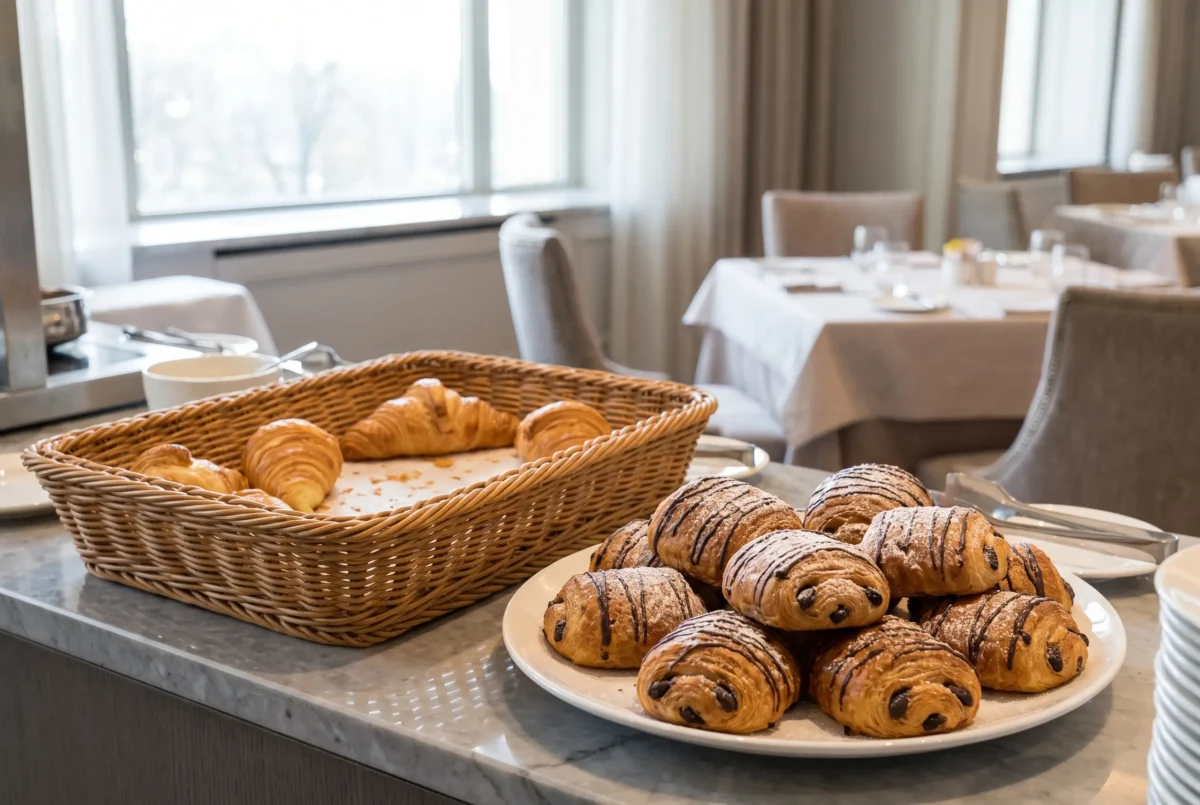
A breakfast buffet is judged at 10:15, not at 7:00. Plan the last hour as carefully as the first, and the waste takes care of itself.
Le’Craft Pastry Team
What to do with what is left
Even the best plan leaves something. Decide in advance what happens to it, within your own food safety rules, so it is not decided by whoever is closing the buffet. A simple A, B, C order works well:
- Plan A: don’t make it. Anything left at close goes straight into tomorrow’s plan as a smaller first wave for that item.
- Plan B: give it a second life. Safe, unserved pastries go to the staff canteen, or back to the pastry kitchen as bread and butter pudding or twice-baked almond croissants.
- Plan C: donate. Programmes such as the UAE Food Bank collect surplus food; check their requirements for what can be donated and how.
Remember that anything that has been on the buffet usually cannot be served again. The real savings come from baking less of it in the first place.
Involve the team
Waste plans fail when they live in the chef’s office. The people who bake, refill and clear the buffet decide most of the outcome.
- Five minutes at the morning briefing: tomorrow’s covers, today’s waves, yesterday’s leftovers.
- One named owner for the bakery corner during peak time.
- Log without blame. If people fear being blamed for waste, they stop recording it honestly, and the numbers become useless.
- Share the wins. Show the team what they saved each month, in pieces and in money.
Measure for two weeks
You do not need special software to start. A simple sheet next to the oven, filled in every morning, is enough to find your real numbers.
| Item | Baked | Left at close | Wasted % | Note |
|---|---|---|---|---|
| Butter croissant | — | — | — | Peak at 8:30 |
| Pain au chocolat | — | — | — | |
| Fruit Danish | — | — | — | Slow after 9:30 |
| Mini muffins | — | — | — |
After two weeks, you will know your take-rate per guest, your slow sellers and the hour when each item stops moving. That is all you need to set your waves and cut the items that are not earning their place.
Plan for peaks
Some mornings break every average. Plan them separately.
- Weekends and holidays. Local guests and longer, later breakfasts change both volume and timing.
- Groups and conferences. A coach of 40 guests arriving at 7:00 needs its own wave, not a bigger first bake.
- Ramadan. Breakfast volumes can fall while suhoor and iftar take over, so move part of your pastry plan to those services.
- High season. When occupancy runs high for weeks, keep more frozen stock rather than ordering bigger daily fresh deliveries.
A frozen range makes peaks easier: the stock is already in your freezer, and you only bake what the day needs. If you are reviewing your breakfast range, our industries page shows how we work with hotels, and you can request the Le’Craft catalogue to see every product and format.
Frequently asked questions
There is no universal number. Measure your own take-rate for about two weeks: the share of guests who take pastry and the average pieces they take. Then multiply by tomorrow’s forecast covers.
Forecast from covers, bake in two or three waves instead of one, use smaller platters refilled more often, offer mini sizes, and deliberately keep the last hour of service smaller.
Buffet breakfasts typically create more than twice the food waste per guest of breakfasts ordered from a menu, and bread and pastry are among the most wasted items. Most of that waste happens before food reaches the plate.
Use smaller platters refilled often, tiered or vertical stands, and neat rows rather than heaped baskets. Keep pastry close to the coffee, label every item, and plan a smaller display for the last hour.
Frozen pastry, especially pre-proved, makes baking in waves easy because each tray goes straight from freezer to oven. Fresh delivery suits small, very predictable volumes.
Often, yes. Minis let guests try more items with less left on the plate. Many hotels keep the butter croissant full size and serve Danish, tarts and muffins as minis.
A butter croissant, pain au chocolat, one fruit pastry, bread for toast, and one or two rotating items. Add a savoury pastry or a local favourite for regional guests.
Unserved items can go to staff meals or be turned into puddings and twice-baked pastries in line with your food safety rules. Items that have been on the buffet usually cannot be served again.
As short as possible. Baking in waves means each tray is replaced before it starts to look tired, usually within a couple of hours.
Planning a better breakfast?
Tell us your covers, your outlets and your busiest mornings, and we will suggest an assortment and a format that fit. Request our catalogue or talk to our team, and we will come back to you within one business day.
